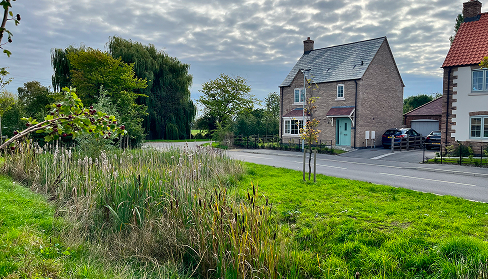
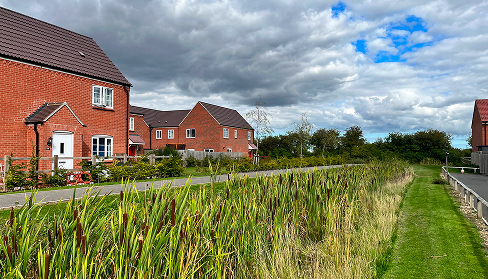
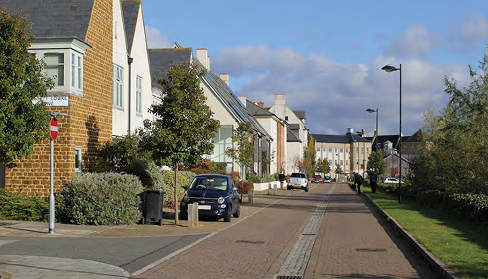
Our streets are for all types of pedestrians, whether walking, using a wheelchair or pushing a pram. They need to be designed for everyone from 8 year olds to 80 year olds - with continuous, clear, direct, accessible and attractive walking and wheeling routes connecting people to work, education and leisure.
Particular consideration needs to be given to removing the barriers to mobility for those with mobility and sensory conditions, or with neurocognitive conditions such as dementia.
The following rules relate to pavements:
Pavements must have a minimum width of 2.0 m. Except where stated in the Better Streets typologies.
Where there are obstacles such as street furniture, the absolute minimum pavement width must be 1.5 m. Provided that:
Pavements must be visually distinct from the carriageway, unless separated by a verge or swale. This can be achieved using visually contrasting materials.
Pavements should be wider in areas of high footfall or gathering (e.g. outside schools)
Inclusive design means responding to the needs of people of different genders, ages, abilities and life circumstances. Design responses should therefore address both physical accessibility and perceived safety, legibility and comfort, supporting equitable participation in active travel and everyday movement.
Key inclusive design requirements are set out below. Further guidance can be found in:
Tactile paving must be used on all designated crossing points (excluding continuous crossings).
To maintain accessibility, walking and wheeling routes must comply with the following:
Tactile paving should be provided at junctions of side roads, and along desire lines.
Walking and wheeling routes should be designed to support feelings of safety and confidence for all users, through:
Regular resting places, including seating, should be provided every 50 m to 100 m.
Complex paving patterns with a variety of colours and textures should be avoided, particularly over large areas, as these could be overwhelming and confusing.
Off-street walking routes can provide opportunities for routes that are more direct than the street network, particularly for off-site connections. Off-street routes can also be more attractive, allowing routes through green and natural spaces, or alongside SuDS features.
In line with Chapter A.5 - Public rights of way need to be maintained or diverted, and can be incorporated into the site.
Off-street walking routes must be a minimum of 2.0 m wide.
Walking routes must comply with the inclusive design requirements set out above (gradients, places to rest, etc).
Where walking routes are wider than 2.5 m, and there is a risk of unauthorised or accidental vehicle access, access to the route must be filtered (gates, bollards, planting)
Maintained Public Rights of Way (PRoW) through the site must be upgraded to accessible standards. This includes new hard surfacing, upgraded access points (gateways, etc) and replacement wayfinding.
Walking routes through public squares and spaces in the Town and Historic area types should be laid in block paving.
Existing Public Rights of Way should be integrated into the site layout, and combined with key walking routes or streets. They should not be segregated or routed behind homes.
Pavement crossovers need to prioritise convenience for pedestrians over cars. Too often this is not the case, and the result is undulating pavements and cycling lanes. The following rules set out the design requirements for vehicle crossings.
A regular, level surface must be maintained across driveways. The level change for a dropped kerb should be achieved using a short ramp, constructed in pavers or using precast units, that maintains a clear, 2.0 m effective pavement width where possible, with an absolute minimum of 1.5 m where in line with the rules above. Pavement and cycle way levels must not drop to the carriageway level.
The crossover must be wide enough to take into account the swept path of the turning vehicle. The minimum dropped kerb width for a single-width residential driveway must be 2.75 m.
Access for commercial vehicles to buildings should be via a pavement crossover.
Lincolnshire has long encouraged good cycle infrastructure. The high-level principles for creating cycle networks are set out in Chapter A.5, and this section provides additional detailed design guidance.
There are three ways of providing a cycle route:
All streets with a design speed of 30 mph or above, must include segregated cycle tracks.
Segregated, off carriageway cycle provision must be provided on the following street typologies:
New one-way streets should allow contraflow cycling, except where there is separate cycle provision such as segregated cycle tracks. The minimum one-way street width with a contraflow must be 4.0 m
Segregated provision on Type 1 and Type 2 streets can be omitted if off-street alternative cycle routes are provided.
The following rules relate to cycle routes that are separate from the adopted street, such as those passing through open spaces.
Off-street segregated cycle tracks (e.g. through parks or open space) must be a minimum of:
1.75 m (one way)
2.5 m (bi-directional)
Where combined with a pedestrian route, the minimum widths are as follows.
3.75 m (one way cycle route)
4.5 m (bi-directional cycle route)
Combined off-street cycle and pedestrian routes must separate cyclists and pedestrians. This can be achieved by:
If there is a risk of unauthorised or accidental vehicle access, access to the route must be filtered (gates, bollards, planting)
The cycle and pedestrian areas should be laid in contrasting materials.
Homes can be served directly from pedestrian and cycle routes - Refer to Street Type 3.D - Cycling Street
The following rules relate to on street segregated cycle tracks. These are typically used on Type 1 Principal Streets. The minimum widths stated exclude a buffer, and these need to be added in most situations such as alongside kerbed upstands, parking bays, or the carriageway. Only cycle tracks alongside footways and greenery do not require a buffer.
Cycle tracks must be separated from vehicles by either:
Kerbs must comply with the following:
Full height: Between 100 mm - 110 mm.
Low height (for stepped): Between 50 mm - 75 mm with 30-45° profile
On-street segregated cycle tracks must be a minimum of:
1.5 m (one direction)
2.5 m (bi-directional)
The following buffer widths must be applied to the cycle track:
Alongside the carriageway and parking, the buffer width of the cycle track should be laid in a contrasting material, or otherwise demarcated.
Designers can defer to the guidance and dimensions set out in LTN 1/20, but the above requirements must be taken as a minimum.
Sharing the carriageway with cars is appropriate where traffic volume and speed is very low. The following rules apply in this situation.
Street and lane widths of between 3.25 and 3.9 m must be avoided, unless there is separate cycling provision. Widths within this range encourage close overtaking of cyclists.
At localised narrowings, such as buildouts or tree pits, a cycle bypass can be provided.
Junctions are often the weakest link in a cycle network. They are where most conflicts occur and can be intimidating for all cyclists. According to Department for Transport statistics, between 2020 and 2024, more than half of all injuries and fatalities occurred at or near a junction.
An unsafe junction will deter people from cycling and sever the wider network, regardless of the quality of the adjoining routes.
Junctions need careful design to separate cycle and motor traffic, or to reduce traffic speed and volume so that different traffic streams can mix safely.
The following rules apply to junctions. Designers should also refer to the guidance in LTN 1/20 - Cycle Infrastructure Design
Where there is a segregated cycle lane priority crossings must be used on lower order side streets. E.g. where a Residential Streets meets an Avenue or Principal Streets.
Junctions between Type 1 Principal Streets should include segregated cycle provision.
Segregated junctions could either use physical segregation or segregation by time, for example by using a dedicated 'cycle only' phase for signals.
Cycle routes can be diverted to avoid the junction completely, instead crossing the streets outside the main junction area.
Another major point of conflict between cyclists and other users is at bus stops, particularly when there are segregated cycle tracks on the street. This will normally be achieved using a bus stop bypass, details of which are provided in section 4.6 - Designing for public transport and bus infrastructure
Wide carriageways encourage faster speeds, are an inefficient use of land and materials and generate more runoff. They also create uncomfortable and unattractive places for people to live.
The Better Streets approach keeps widths to the minimum possible while maintaining safe and free movement of people and vehicles.
A regular cross section is not always desirable, and a variation in the width of the street adds character and enables opportunities for green space, parking and other uses.
Type 2 and Type 3 streets in the Rural Area Type should include some variation in the carriageway width. This can be used to provide informal parking, passing places, and SuDS.
Type 3.A Shared Space and Type 3.B Edge Lane streets in Suburban Area Type should include some variation in width to provide informal parking, passing places, and SuDS
Carriageway widths can vary to accommodate existing mature trees.
As well as varying the carriageway, designers can also introduce irregular central reservation areas to introduce greenery or other uses and break up the carriageway.
The width of central reservations or islands must comply with the table below.
Type 1 Principal, Type 2 Residential and Type 3.A Shared Space streets can include a large central reservation or island. These would be smaller than a formal square or circus, but would provide open green space for residents, or opportunities for sustainable drainage systems (SuDS).
Principal streets can include a flush paved strip in the centre. This is a good alternative to road markings and helps visually narrow the carriageway.
| Type | Minimum Width |
|---|---|
Planted with trees | 2.5 m |
Paved or low-level planting | 1.5 m |
SuDS feature such as rain garden or swale | 2.0 m |
Parallel on-street parking | 3.0 m |
Perpendicular on-street parking | 6.0 m |
Flush paved strip | 0.45 m |
In 2024 a total of 431 people were killed or seriously injured on roads in Lincolnshire, and even as the network expands that number must keep getting lower. Better Streets also means safer streets.
Traffic calming does not always mean speed bumps and cameras. Streets that are designed well, incorporating the requirements of this code, will be intrinsically safe and encourage careful and considerate driving. Design features that put people, place and nature first will help achieve the objective of safer streets without resorting to hard engineered solutions.
This can be achieved by following the traffic calming hierarchy
All new streets in residential developments must have a maximum design speed limit of 20 mph and design speeds must be in accordance with the street typologies.
Any horizontal or vertical deflections must be spaced between 60-70 m apart.
When new developments are accessed from a strategic route, designers should consider the transition from the fast road to the slow residential streets.
Intrinsic measures make driving slowly, carefully, and considerately second nature. Streets are places people call home, they should not feel like a racetrack and driving fast should feel uncomfortable.
The following features, which are required by this code, help make streets intrinsically safer:
Where curves are introduced to calm traffic, these should relate to the building line and should not result in left-over space.
Horizontal deflections narrow the street, sometimes reducing it to allow only one vehicle to pass. This includes features such as buildouts or islands.
While vertical deflections on their own are considered a last resort, they are an integral part of features such as continuous crossings and raised table junctions. These serve a dual purpose - raising the carriageway to the level of the footway, and slowing traffic.
Horizontal and vertical deflections are usually combined to improve their effectiveness - E.g. at raised table crossings.
The carriageway must not be narrowed to less than:
Buildouts must be multi functional and provide either:
Standalone speed cushions and speed humps must not be used.
A cycle bypass should be provided at pinch points between 3.2 m and 3.9 m wide
Vertical deflections, where required, should be combined with crossings.
S-shaped sinusoidal profile ramps can be used on vertical deflections to provide more comfortable cycling.
Connected, permeable street networks are required in all but exceptional circumstances (Golden Rule 4.1). Where turning heads cannot be avoided — for example, on small infill sites — wide expanses of unbroken tarmac are not acceptable. Good street design and placemaking principles must still be applied.
Where cul-de-sacs are unavoidable, the must be designed as either:
The following design rules apply to turning heads:
There must be adequate space for safely turning large vehicles. Vehicle tracking must be undertaken to demonstrate this.
The turning area must be kept free of parked vehicles. This can be achieved by providing clearly demarcated parking areas.
Turning heads should incorporate greenery, including street trees and SuDS.
The building line should be used to frame the area and ensure it is overlooked and has a sense of enclosure.
Any central island or square on a turning loop should be at least 60% greenery by area. This can include trees and SuDS.
Well-designed, sensibly-located crossings that feel safe and comfortable to use are essential for creating people friendly and accessible streets. The lack of such facilities is a barrier to movement and connectivity and disproportionately disadvantages those with accessibility issues.
The following design principles apply to pedestrian and cycle crossings.
Crossings must follow pedestrian desire lines and provide the shortest route possible. Particular attention must be given to key amenities and attractions (e.g. bus stops).
On Type 1 Principal Streets crossings should be provided at least every 100 m.
Crossings should be as short as possible, and ideally single stage.
Crossings should be combined with traffic calming measures such as narrowings or raised tables.
There are two types of crossing covered in this code:
These are uncontrolled crossings that are common on all developments, they include:
Formal crossings are normally only required on busier streets.
Continuous crossings, sometimes called Copenhagen crossings, prioritise pedestrian comfort and are effective at calming traffic. They are extensions of the pavement surface across the mouth of a side street junction - for example where a Type 2 Residential Street meets a Type 1 Principal Street.
The benefits of continuous crossings include:
Continuous crossings should be used instead of courtesy crossings on the transition between
The crossing should be the same width as the main pavement and use the same surfacing material.
The crossing should be raised to the same level as the pavement, to provide a level surface for pedestrians and wheelers and reduce vehicle speeds.
Raised table crossings are constructed on the carriageway between junctions, rather than at side street junctions. They are designed to signal pedestrian priority and provide traffic calming, improving safety and accessibility.
Raised tables must be constructed at the same level as the footway, with a minimum width of 2.0 m.
The crossing must be constructed in either:
The crossing should incorporate buildouts to narrow the carriageway, where the width is greater than 5.0 m.
Courtesy crossings, or uncontrolled crossings are simple crossings that have dropped kerbs and tactile paving.
The crossing should be the same width as the main pavement, with a minimum of 2.0 m.
The crossing can be demarcated by laying it in a material that contrasts with the carriageway. For example, using a buff surface course.
For areas with a combination of high traffic and high footfall, zebra crossings can be used to provide pedestrians with priority so they can cross the street in comfort. Parallel crossings also include space for cyclists.
Formal zebra and parallel crossings should be used in conjunction with a raised table. Refer to the rules for raised table crossings above.
The choice of materials is key to the attractiveness, longevity, ease of maintenance and sustainability of street design.
To ensure streets can be maintained effectively over the long term, this chapter establishes a simple and standardised palette of materials and street furniture for use across Lincolnshire. Limiting the number of materials used in adopted streets makes replacement and maintenance practical, while still allowing appropriate design choice that reflect their local context.
While asphalt is widely used and initially affordable, it generally requires higher levels of maintenance over its lifespan than materials such as clay or concrete block paving. It is also highly impermeable, increases surface water runoff and contributes more to heat build-up in streets. For these reasons, the palette set out in this chapter limits the use of asphalt, particularly in footways and public spaces.
The following palette must be used for all adopted streets on new developments. Refer to Part C - Delivering Better Streets.
Materials selected for use within conservation areas must respond to the established character of the area, drawing on the Character Assessment (if available) in addition to this design code. Choices must reinforce local distinctiveness and preserve or enhance the special qualities that contribute to the area's heritage value.
All materials for roads must be obtained from a source and supplier approved by us. See our Approved suppliers list in Part C - Delivering Better Streets.
Footway surfaces must provide slip resistance and an even walking surface to ensure safe and accessible movement.
Edge course must always be used with block paving, unless it is laid parallel to the edge (i.e. stretcher course).
A maximum of two colours of paver should be used on a street.
The palette sets the minimum adoptable standard. Developers can suggest a higher specification of material than those recommended in the palette for each area type and street type.
Pavers should be used:
Pavers should be concrete.
Pavers must be laid in herringbone pattern within the carriageway.
Pavers should be laid in stretcher pattern (straight) in cycleways and footways.
One of the following colours must be used for pavers: Natural, buff, grey/charcoal or brindle
Standard pavers must be one of the following sizes:
Conservation block paving should be used in preference to pavers in pedestrian-priority locations where a higher-quality surface is required such as key public spaces and junctions.
One of the following colours must be used for conservation pavers: Natural, buff and grey/charcoal
Conservation pavers must be one of the following sizes:
Conservation setts should be used sparingly at key points in a development e.g. at a key junction or marking an entrance to a street.
Conservation setts must be laid in stretcher (straight) pattern.
Conservation setts must either be granite or concrete and must be silver-grey in colour.
Concrete setts must be one of the following sizes:
Granite setts must be one of the following sizes:
Where tarmac is used in the carriageway, it should be used in conjunction with block paved or stone channels and edging to reduce the dominance of tarmac.
Where tarmac is used on cycle ways, there must be a clear and distinct separation between footways and cycleways, particularly for users with visual impairments. Coloured tarmac must be used in the following situations:
Coloured tarmac can be used selectively to signal crossings or shared surfaces, subject to approval.
Contrasting colour aggregate can be used to differentiate between different functions, for example parking bays and raised tables.
Permeable paving is an effective tool for reducing surface water runoff that can be easily integrated into any street. It is not appropriate everywhere and needs careful specification and detailing.
Permeable paving must only be used in the carriageway on lightly trafficked Type 2 streets and Type 3 streets.
Permeable paving must not be laid above utilities - an impermeable service strip can be created if required.
Permeable paving can be used in parking bays and footways in Type 1 streets.
Permeable block paving must be laid in herringbone pattern within the carriageway.
Permeable paving should be laid in stretcher pattern (straight) in cycleways and footways.
One of the following colours must be used for permeable paving: Natural, buff, grey/charcoal or brindle
Permeable pavers must be one of the following sizes:
In plain English, a mobility hub is a place where different transport options come together - such as bus services, cycle parking, car clubs, and more. This provides more choice, more convenience, and allows more seamless journeys, making it easier for residents to get around. On larger new developments, mobility hubs bring these options together in one convenient, well-designed location alongside other community facilities and amenities.
The need for a mobility hub (or hubs on larger sites) will be identified and agreed at the pre-application stage, but most developments over 80 homes will be expected to provide them.
There are three levels of hubs referred to in this code:
The table below lists what facilities and design elements can be included in mobility hubs, and the following rules set out how to design new hubs.
Reference can also be made to the Homes England document Delivering Quality: Mobility Hubs (March 2026).
Primary, or Core Hubs must be located alongside other community uses and amenities, including bus routes.
Primary hubs must provide facilities for at least 3 transport modes, excluding walking.
Secondary hubs must provide facilities for at least 2 transport modes, excluding walking.
Primary and secondary hubs must include placemaking elements and information points, as set out in the table below.
Hubs must be accessible and understandable for all users, including those with disabilities
Homes should be within 1,200 m walking distance of Primary Hubs or 500 m from Secondary Hubs and Mobility Points.
Hubs should be accessible from all parts of the development by walking, wheeling or cycling.
| Transport | Facilities | Placemaking |
|---|---|---|
|
|
|
Well-designed, safe and attractive bus stops are essential to increasing the appeal and convenience of public transport. New bus stops will be required to comply with the following rules.
Bus stops must include seating, either standalone or integrated into the shelter.
Bus stops must be in well-lit locations, or adequate lighting must be provided.
The bus stop must be designed to maintain a 2.0 m clear pavement width, accounting for the flag and bus shelter. This must be increased to 3.0 m where there is a shared cycleway and footway on Type 2 Residential Streets.
All bus stops should include a shelter
Bins should be provided at all bus stops
Bus stops should include real-time passenger information (RTPI) screens. Screens can be integrated into the shelter or be standalone.
The combination of both bus stops and segregated cycle tracks creates a potential conflict between cyclists and pedestrians, with safely implications for both. Bus stops need to be designed to be safe, comfortable and attractive for both cyclists and pedestrians. As most new bus stops will be on Principal Streets, which have a segregated cycle track, this will affect most new bus stops.
Where a bus stop is situated on a street with a segregated cycle track, a bus stop bypass must be used. This does not apply to where a shared cycleway and footway is used on Type 2 Residential Streets.
Shared-use bus boarders, where passengers board or alight directly into the cycle track, must not be used. Passengers must be able to board a bus from the waiting area without crossing the cycle track.
A bypass is when the cycle track is taken behind the bus stop, allowing enough space at the kerbside for a shelter and waiting area. A pedestrian priority crossing will provide access across the cycle track. This is also know as a 'floating bus stop'. The following rules set out the design requirements. Reference should also be made to the latest Department for Transport statutory guidance.
To encourage slower cycling, the cycle lane alongside the bus stop must be reduced in width to between:
The bus stop island must be a minimum of 3.5 m wide. This can be reduced to 2.5 m if space is constrained.
A pavement level crossing of the cycle tack must be provided, incorporating:
A rumble strip, and changes in horizontal alignment, can be used on the approach to the bus stop to encourage cyclists to slow down.
The bus stop island can incorporate greenery, including trees and SuDS.
Shelters are key to creating accessible and comfortable bus stops that help make services attractive. They are also significant features in the public realm, and need to be attractive additions to our streets. Lincolnshire County Council have standardised bus shelter types, refer to the technical specification for drawings and details.
Bus shelters must be designed sympathetically to their surroundings. In the Rural area type a 'rural' style bus shelter must be used.
Side panels must be provided on all shelters.
Bus shelters could include a green roof or solar panels
Refuse access needs to be carefully considered and balanced with other requirements. The geometric requirements for large refuse vehicles can lead to large turning radii, wider streets and large turning heads that conflict with the requirements of this code.
Refuse storage needs careful consideration. Where storage is not convenient, residents will often store their wheelie bins in their front gardens, on their driveways, or on the public footway. This can be avoided through good design.
As a two-tier authority area, waste collection is undertaken by the district councils, and any waste collection strategy will need to comply with local requirements.
A refuse vehicle must not need to reverse more than 12 m on Type 2 Residential and Type 3 Tertiary Streets, and no reversing is permitted on Type 1 Principal Streets.
All domestic refuse collection must be from the adopted carriageway, except in specific circumstances agreed with the district council.
Collection of domestic waste from unadopted roads must be approved by the waste management team in the relevant district council at the pre-planning stage.
For unadopted streets and Type 3 Tertiary Streets that do not have vehicle access a collection point must be provided on the edge of the main adopted street to allow collection.
Where refuse storage is on plot, adequate storage must be provided for 4 wheelie bins plus one food waste container.
Collection points must be located no more than 30 m from the properties they serve and refuse vehicles should be able to get within 25 m.
Bin storage should not be at the front of the house where possible and instead should be in garages, or to the rear or sides of homes.
As an alternative to collection points communal bin stores could be provided to serve houses on unadopted streets.
Details of the largest refuse vehicles used in each District are set out below. These need to be used with caution.
The requirements for refuse vehicle access must not override the street widths and junction geometries set out in this code. In most circumstances, it is acceptable for such vehicles to take up both lanes when turning at junctions.
Where there is any concern, vehicle tracking should be used to demonstrate access.
For sites within existing settlements, designers should use the type of vehicle that is currently used in the surrounding streets as this may be smaller than the design vehicle.
| District | Width (m) | Length (m) |
|---|---|---|
East Lindsey | 2.25 | 7.875 |
Boston | 2.55 | 11.6 |
South Holland | 2.55 | 11.6 |
South Kesteven | 2.2 | 11.23 |
North Kesteven | 2.5 | 10 |
Lincoln | 2.25 | 10 |
West Lindsey | 2.32 | 10.223 |
Utility routing can have a significant long-term impact on the future maintenance and street use. Poorly routed utilities can cause disruption, delay upgrades, and prevent maintenance and emergency access. Poor planning of diversions and connections can also lead to delays and excess costs for new development, and even prevent occupation of completed housing.
It is vital that the siting of utilities and services is considered as part of the street design process, and not retrofitted to a predetermined layout.
Hard landscaped service margins are to be avoided. Narrow hard surfaced strips are perceived by pedestrians and drivers to be footways, creating confusion and potential safety issues. For this reason, Lincolnshire County Council will only accept soft landscaped service margins.
The following rules apply to new utilities. Reference should also be made to the technical specification.
Services must be grouped together in a designated service strip, clearly marked on plans at the master planning stage.
Utilities must be located in one of the following:
If used, service margins must be soft landscaped (grass, herbaceous, small shrubs) not hard surfaced.
Designers must consider the siting of trees, landscaping, SuDS assets and street lighting columns when determining corridors for utilities and services. These must have priority over utility routes - it will not be acceptable to omit trees and SuDS due to poorly planned utilities.
The number of dedicated service crossing points should be kept to a minimum.
Utility covers should be sited to avoid conflict with tactile crossing points.
Please refer to The National Joint Utilities Group publications
Good quality street furniture contributes to a sense of place and helps create streets that are well looked after. The starting point for any well-designed street is to begin with nothing and add only what is necessary. Unnecessary furniture creates visual and physical clutter, narrows effective pavement widths and increases maintenance costs.
Street furniture such as benches, bins, and artwork may be sited within the adoptable public highway, but maintenance arrangements need to be agreed with a responsible body such as a district or parish council, a community trust or a management company.
Street furniture must not impede pedestrian movement in the street or reduce the pavement width below 2.0 m (this can be reduced to 1.5 m in constrained sites).
Street furniture and signage must be kept to a minimum to reduce visual and physical clutter, and consolidated where possible.
A maintenance agreement must be in place before any street furniture (excluding bollards) is installed on the adopted highway.
Bollards should be designed out whenever possible, but are sometimes unavoidable to prevent nuisance parking, overrunning or unauthorised access. They are particularly useful for filtering streets and preventing access, accidental or otherwise, to walking and cycling routes.
Plastic bollards must not be used. They are prone to damage, weathering, and discolouration.
A maximum of two bollard styles must be used across a development.
In the Town or Historic Area Types cast iron or steel bollards should be used, including 'bell' type bollards. These should match existing bollards on surrounding streets if present.
In the Rural Area type, timber bollards should be used
Natural stone boulders, at least 500 mm in diameter, can be used as an alternative to bollards in Rural and Suburban Area Types.
Litter bins are not within the highway authority's maintenance remit, but their location and design affect the quality of the street. Maintenance will be undertaken by a responsible body such as a district or parish council.
Litter bins should be provided on Type 1 Principal streets and in public spaces such as parks, playgrounds and squares.
Bins should have partially enclosed lids to prevent overspill and the spread of litter.
Seating is not within the highway authority's maintenance remit, but it is an important part of creating walkable streets that are comfortable and accessible for all. Maintenance arrangements will need to be agreed with a responsible body, such as the district or parish council.
Benches must not back directly onto the carriageway or a busy pedestrian route - this is uncomfortable and will reduce their utility.
Benches should be located in areas where people will find it most comfortable to sit. This is generally at the edges of public spaces, in areas that offer shade, close to amenities, or simply somewhere with a good view.
Benches should have back rests and arm rests to be accessible and age-friendly, unless where this conflicts with other accessibility requirements.
The following rules apply to street signage. Reference should also be made to the technical specification.
Signs should be kept to a minimum to avoid confusion and visual clutter.
Where signs are required, they should be attached to buildings or other structures, such as lamp posts, or grouped to reduce the number of posts required.
Clear boundary treatments are essential to creating a well-defined distinction between public and private space, as required by Golden Rule 9. A lack of boundary treatment creates weak, undefined frontages, without clear ownership and maintenance liabilities.
There must be clear demarcation between public and private space at the boundary of private plots and the adopted highway. Front gardens and drives must be defined through boundary treatments such as walls, hedges, shrub planting or railings. Refer to the landscape and planting section for rules on boundary hedges.
Full-height fencing must not be used to demarcate front gardens and driveway.
Where rear or side garden boundaries front the adopted street, close board fencing must not be used as a boundary treatment.
Front garden boundary treatment should be no greater than 1.0 m high.
Street lighting is a key component of creating streets that are safe and welcoming at all times of day, in all seasons and in all weather. Lighting design should consider how all users, including vulnerable users, will move through the street — including along link footways and cut-throughs within the site and to the surrounding community.
Lighting design must be in accordance with the LCC Street Lighting Policy.
Lighting should minimise light pollution and avoid unnecessary upward light spill, particularly at the edges of developments adjoining open countryside.
Developers can use lighting outside the adopted highway boundary to provide illumination of streets and footways. This could include building mounted luminaires, or illuminated bollards, as well as conventional columns.
The positioning of street lighting columns needs to be coordinated with tree planting, utilities and other street furniture to avoid conflicts and future maintenance problems.
Lighting columns should be positioned to avoid cluttering the pavement.
Wall mounted luminaires can be used in the following street typologies:
Type 3.A Shared Space
Type 3.C Town Mews
Type 3.D Cycling Streets
This will not normally be adopted and will remain privately maintained.
Lighting impacts the character of the street and the wider place - street lighting columns are a very visible piece of street infrastructure that can detract from the appearance of a street if not well designed.
All street lighting columns and luminaires must be to LCC's standard specification.
All new street lighting columns and luminaires in Historic Area Type should be 'heritage style' and must match local styles.