There are 30 Golden Rules for designing Better Streets in Lincolnshire. These are designed to allow rapid assessment of proposals and clear direction at the earliest design stages.
They form a checklist of simple design rules. Any site that complies with all the Golden Rules will:
Developers are strongly encouraged to refer to the Vision, Principles and Golden Rules from the very earliest stages and use them to inform site capacity, feasibility and viability studies.
Planning and highways officers should use the Golden Rules to undertake a rapid assessment of designs at all stages, particularly at pre-application and outline planning.
Designers should refer to the Golden Rules throughout the design, continually checking layouts and designs against the Golden Rules.
The following 8 Golden Rules relate to site analysis and master-planning. They align with the requirements in Chapter 5 – Master-planning of Part A - Planning Better Streets.
New developments must respect the existing landscape and work with it, not against it. Mature trees (as defined by BS 5837) should be retained wherever reasonably practicable, with removal only where clearly justified. Levels must work with existing topography and watercourses.
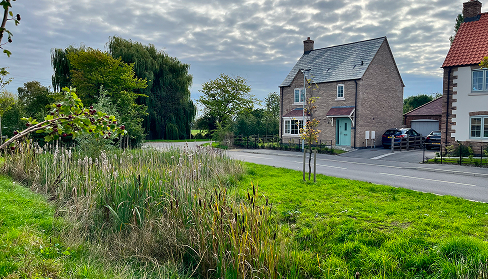
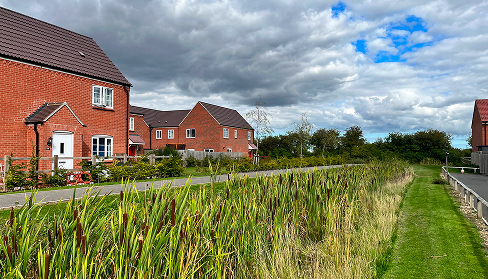
Sustainable Drainage Systems (SuDS) features must be well integrated and distributed throughout the site, using a range of solutions that are simple, legible and easy to maintain. Sites should not rely on single 'end of pipe' storage features, such as large basins and ponds. This can be achieved by following existing drainage routes, mimicking existing runoff conditions and splitting the site into sub catchments - each draining to a different SuDS feature.
The site must deliver a permeable, connected street network that supports walkability and legibility. Tree‑like patterns are not supported. Cul-de-sacs and turning heads must be avoided where possible.
Connectivity and context outside the red line must be considered. Does the proposal maximise opportunities for convenient cycle and pedestrian access as well as cars? Developments should not rely on a single entrance. The site must 'plug in' to existing street network and public rights of way restoring previous block patterns where possible.
Access to key amenities, such as local schools and shops, must be possible by walking or cycling as well as driving, maximising choice and freedom of movement for residents. Traffic free connections should be prioritised, and access to existing amenities as well as proposing new ones should be considered.
Provision must be made for future access to adjacent development in site plans. Where feasible, developments should include streets and pedestrian routes that can be extended in the future, and the adoptable street extended to the site boundary.
Blocks must create a distinct separation between public and private space. There must be a robust block structure with clear fronts and backs.
There must be no undefined 'space left over after planning' (SLOAP) in what could be understood as the public realm. This helps reduce the maintenance burden on residents and ensures efficient land use.
The following 22 Golden Rules relate to the design of streets, greenery and sustainable drainage. They align with the requirements of Part B - Designing Better Streets.
Developments must have a clear hierarchy of streets in accordance with the Better Streets typologies in this code. The character and use of a street will depend on its place in the hierarchy, from primary routes for movement to quiet neighbourhood streets.
Street junctions must be designed around all users, not just vehicles. In practice, this means tight corner radii, crossings on key desire lines and provision for cyclists. Large roundabouts, based on the Design Manual for Roads and Bridges, must not be used.
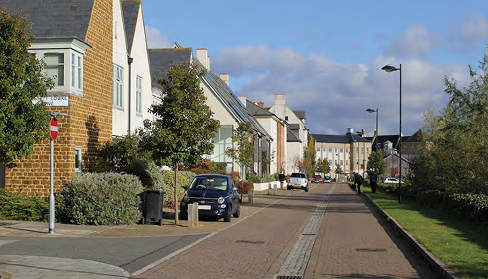
All new streets must include regular street trees, spaced 8 to 20 m apart, and other greenery such as ground cover planting and natural drainage features. Trees may be omitted from narrower mews streets, but some ground cover planting must be included.
Blue green infrastructure (greenery, green space, sustainable drainage etc) should be multi-functional to maximise benefits and make efficient use of space. It should provide a mix of flood risk mitigation, water quality, amenity and biodiversity. In particular, sustainable drainage must be safe for children to play in and around. It should not be fenced off and hidden away.
To make cycling convenient and attractive, on-plot cycle parking must be secure and covered, and as convenient to access as the private car. For example, in a porch, garage or a dedicated cycle store.
A range of parking solutions are available. Developments should not rely solely on front driveway parking. This includes side parking, garages, on-street parking, parking courtyards, and other communal parking facilities. For major developments, no more than 50% of homes can have front driveway parking.
Whether on plot, on street, or elsewhere, parking areas must be broken up with trees and other greenery to reduce the dominance of parking. For on-street parking, this is no more than every four parallel spaces or every six perpendicular spaces.
Pavements and walking routes must be safe, comfortable and accessible for all users of all abilities. Pavements should have a smooth surface with regular levels and be laid in contrasting material to the carriageway. Off-street routes should not be routed behind buildings; they should be alongside active building frontages to allow natural surveillance.
All streets must allow safe cycling, with a level of segregation appropriate to the speed and volume of traffic, in line with the Better Streets typologies. Ask the question, 'would I let my child cycle here?'
Streets must be designed to encourage slower, more considerate driving. All streets in residential areas must have low maximum design speeds. This can be achieved through alignment design and the use of features such as street trees, buildouts and on-street parking, modular paving, as well as horizontal deflections, and continuous crossings.
Routes to school should incorporate 'Play on the Way', creating child-friendly spaces integrated into the street, rather than segregated play areas.
New streets must not be edge-to-edge uninterrupted tarmac. Designers must use the palette of materials set out in this code for adoptable streets, and appropriate blue and green infrastructure. This is a simple palette of robust, locally appropriate materials that will stand the test of time and reduce the maintenance burden for Lincolnshire County Council. As a minimum, pavements should be laid in a contrasting material to the carriageway or be separated from it (e.g. with a verge or swale).
Crossings must be provided on key desire lines and provide the shortest route. Multistage crossings should be avoided wherever possible. Continuous crossings, which provide an uninterrupted level route for pedestrians, should be provided on minor side streets.
Bus routes serving new developments must be as direct as possible to keep journeys short and convenient. This can be achieved by following the street hierarchy and routing buses along primary or secondary routes.
Bus stops should be attractive, appropriately overlooked and suitably prominent within the street scene, without being ugly or intrusive.
Where new routes are created, bus stops should be spaced to ensure the majority of homes are within 300 m of bus stops ('as the crow flies' distance) with 500 m as the absolute maximum. Walking and cycling connections to existing bus stops should be considered.
Bin storage and collection must be considered from an early stage and must not lead to bins obstructing the street, at any time.
Storage and collection points must be identified on site plans. They should be concealed and sensibly located. They must be accessible from the adopted highway and no more than 30 m from the properties they serve. Refuse vehicles should not need to reverse to access any refuse storage or collection points.
Streets must never be designed around refuse vehicles. For example, junction radii should not be set to suit large vehicles that traverse it only once a week. On residential streets, vehicles can instead use both sides of the carriageway to manoeuvre.
Street furniture and lining must be kept to a minimum to reduce visual and physical clutter.
Benches, and other places to sit, are encouraged and should be created on key routes subject to discussion with the District Councils regarding ownership and maintenance.
Lighting design must be in adherence with the LCC Street Lighting Policy.