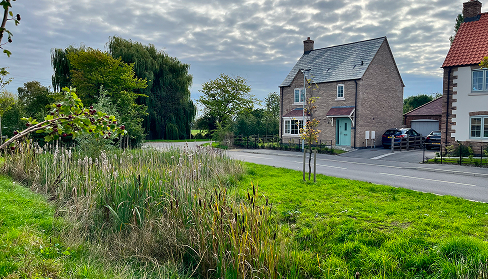
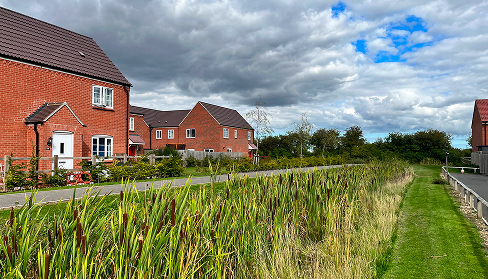
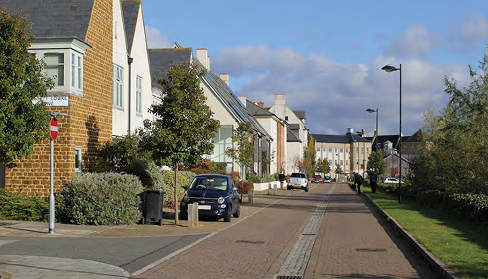
A common complaint about new development is that it feels 'placeless' and 'could be anywhere'. As set out in the Context chapter, Lincolnshire has a rich and diverse built environment heritage to draw upon. This will be achieved by selecting the right area types as described in Section A.3.2 – Area Types, as well as through use of the appropriate materials (refer to Section B.3.7) and street typologies (refer to Chapter B.1 - Street Typologies).
Block structure and urban grain (that is the size of plots) will also have an effect on character. A rural site may have a more informal organic pattern with larger plots. A town centre site will have formal character and a grid like street pattern, with smaller plots and a continuous building line.
In order to create good places, it will not always be appropriate to emulate the existing built form and character of the surrounding streets. Many newer places have poor block structure and lack permeability and locally distinct character.
Smaller developments (under 50 homes) should emulate the block pattern and character of the surrounding streets. The exception is when the surrounding context is poor-quality design and would not meet the requirements of this code, or when a higher density of development is required (e.g. to meet density minimums)
Larger sites (over 50 homes) can define a different block pattern and character in order to achieve higher densities.
It is important to create places that respect the surrounding context and properly integrate with their surroundings, rather than ones that turn their back on existing streets and feel like places apart.
Sites must be designed as extensions to their respective places and streets, rather than being designed as an isolated estate.
Residential and mixed-use development must front onto existing streets.
Where a settlement expands and new residential development adjoins a main distributor route, that road must be redesigned as a street in line with this code. It must include a clear street frontage.
As described in Section A.3.2 - Area Types above, there are four proposed area types:
The following rules set out how to use Area Types.
Where the Area Type has been set by the Local Planning Authority, this must be used.
Major sites of over 250 homes must include at least two Area Types.
Area Types should be agreed with Lincolnshire County Council at the pre application stage, and before the site is submitted for planning. This will help set key design parameters and prevent abortive work.
The Better Streets approach to blue green infrastructure is that it should integrated into the design of streets and considered from the very outset. Greenery works best when it is interwoven into the fabric of places, through tree lined streets, verges, residential squares and village greens, rather than a 'public open space' tucked away in the corner of the site. Greenery needs to be on the doorstep and accessible to all.
Greenery should also be multifunctional. Well-designed Sustainable Drainage Systems (SuDS) intercept water runoff, slow it down and manage downstream flood risk, while improving water quality and providing benefits such as enhanced biodiversity, beauty and amenity. Integrating SuDS into the streetscape will help realise these benefits and create a more efficient drainage system.
The following rules set out how to achieve this approach in practice.
All new streets must include trees or other greenery, in line with the Better Streets Typologies. Further details are provided in Part B, Chapter 2.
Sustainable Drainage Systems must be integrated into the design of the site, and be multifunctional wherever possible.
Small scale, above ground SuDS should be prioritised over large attenuation ponds or below ground attenuation systems.
Green spaces should be used to create focal points, such as small squares and village greens, and fronted by streets and buildings. On larger sites these should be distributed throughout.
Sites work best when they respect an existing site's natural features. There will always be trade-offs. The ideal compromise between good urban form and existing natural features may not be possible, but with careful design many features can be retained.
A well-designed site will play to the strengths of the natural topography, maintains existing drainage patterns and integrates existing green and blue infrastructure.
Existing significant healthy trees must be retained.
Wherever possible, mature trees should be used to provide an anchor for proposed green spaces.
Existing hedgerows should be retained and integrated into the layout of development.
New developments should work with existing site topography and seek to minimise level changes, unless flood mitigation measures dictate otherwise.
Existing flow paths, as identified on the Natural Drainage Catchment Plan, should form new drainage paths and existing ditches, ponds and watercourses should be retained and integrated.
Retained green and blue infrastructure features should be integrated into publicly accessible spaces, and be fronted by streets and buildings, wherever possible. They should not be hidden away behind buildings, or in inaccessible areas.
Existing trees and hedgerows can be integrated into the proposed streets and form part of the adoptable highways. For example, an existing mature tree could be integrated into a verge or junction, and a hedgerow could form a central reservation.
Infill sites in Town or Heritage area types can be exempt from these requirements if agreed during pre-app process. For these sites, integration with the existing urban fabric is more important.
For masterplans to incorporate and enhance these existing site features it is vital to understand and analyse the site context.
All medium and major developments (above 10 homes) must submit an Existing Site Plan setting out key natural features and other constraints.
All medium and major developments (above 10 homes) must submit a Natural Drainage Catchment Plan setting out the existing natural drainage condition.
In line with the Better Streets vision and principles, this code seeks to create streets that are safe for all users to move around freely. This means putting people first – at the top of the movement hierarchy.
This is not about making it harder to get around by car, rather it is about making it easier to move around by foot, bike, or public transport as well. It is about providing direct, convenient routes to that link homes, shops, schools and workplaces. It is about creating safer, accessible streets that allow children and those with reduced mobility to move around freely.
The Better Streets for Lincolnshire typologies simplify the design of street networks. Each street type has characteristics that suit its function and place in the street network. In general, streets are designed to balance their 'movement' function (how well they move people) and their 'place' function.
There are three main typologies:
- Principal: High movement function. Serving as the main route in a development. Supports two-way traffic with a regular cross-section and designed to accommodate buses. Developments of below 80 homes will not typically require a Principal street.- Residential: Lower movement function, high place function. These will form the bulk of streets in new developments. Designed for low speeds.- Tertiary: Low to zero movement function, and the highest place function. This includes lanes, mews and other very low traffic, or traffic free streets.Full details of the street typologies are set out in Part B - Better Streets Typologies
Most new developments will not be of a sufficient size to require a Principal street, it is expected that the bulk of new streets will be Residential and Tertiary streets.
New streets must be designed in accordance with the Better Streets Typologies, unless agreed otherwise during the pre-application process.
New street networks must have a clear hierarchy, using different street typologies. The exception is where smaller development will only create a single new street.
A street typology plan must be submitted for all new developments which include new adoptable streets. Each street must be labelled in accordance with the Better Streets Typologies.
Street typologies should be appropriate for the scale of the development - not every development will require a Principal street. Some smaller developments may only require Tertiary streets.
Getting the street network right is critical as the street network will outlive the buildings that it serves. Lincoln High Street and several other historic high streets follow street alignments originally set out by the Romans.
Permeability describes how well-connected a site's internal layout is and therefore how easily people can move through and navigate it. The Better Streets approach aims to create permeable, legible new neighbourhoods that are easy to walk and wheel through.
New developments must have a permeable street network that 'plugs in' to the surrounding streets, paths, and rights of way.
Dendritic, or 'tree like', development patterns that have been common in suburban development must not be used where practicable.
Direct routes for pedestrians, wheelchair users and cyclists must be provided to connect homes with amenities, public transport (train stations, bus stops) and schools outside of the boundary.
All developments must maximise opportunities for pedestrian access, including passive provision for future connections.
All developments of more than 80 homes should have more than one vehicle access point.
Where blocks are longer than 150 m, or junction spacing on opposite sides of the road is greater than 50 m, a ginnel (passageway) can be introduced through the block to maintain permeability and convenient walking routes.
Permeable streets have one major drawback: they enable through traffic on quiet residential streets thereby reducing the amenity of those streets. Traditionally cul-de-sacs were used to mitigate this problem and improve privacy and safety. However, they make it far less convenient for walking and wheeling.
On new developments, the best of both worlds can be achieved through filtering from the outset, preventing 'rat running' while keeping all streets open for pedestrians, wheelchair users, cyclists and sometimes buses. This creates neighbourhoods that remain accessible by car for residents while being walkable, convenient, and safer for all users.
Filtering must be considered on all Residential and Tertiary streets to prevent rat-running.
The location and type of filters must be marked on the masterplan.
New places need to plug in to the surrounding streets and provide good connectivity between homes and village with town centres, amenities, workplaces and schools. These routes need to be as direct and convenient as possible and be safe and accessible enough for children and those less able to use.
It is therefore critical to think 'beyond the red line', considering both the existing context and potential future development.
Opportunities to connect development with neighbouring communities, amenities and workplaces must be maximised. Major connectivity gaps beyond the site boundary must be identified.
Gaps in connectivity must be addressed through the creation of new links or by improving existing connections. This includes footpaths, bridleways, unofficial 'desire lines' and cycle routes.
Access to future adjacent sites and phases must be considered in the layout. Developments must include streets or pedestrian routes that can be extended into future phases, adjacent allocated sites or those with the potential for future development.
Streets designed to provide access to future phases must be adopted up to the site boundary.
Existing Public Rights of Way which run through sites must be maintained.
Those Public Rights of Way that are affected can be diverted to better integrate them into the site layout.
Development proposals need to demonstrate how site layouts achieve effective internal and external connectivity for pedestrians, cyclists, public transport and vehicles. A proportionate Connectivity Assessment, typically in plan form, will illustrate existing and proposed connections, route directness, block structure and opportunities for future links. It needs to demonstrate how layouts prioritise permeability and integrate with surrounding communities while avoiding unnecessary cul-de-sacs or barriers to movement.
Connectivity should be considered at the master-planning and layout design stage. It should be proportionate to site scale. Larger sites will need to undertake analysis using isochrones to show what amenities are within reasonable walking and cycling distance. Smaller sites may use simple assessments showing approximate distances. These can be demonstrated on the site layout drawing.
Street layouts demonstrating poor connectivity or unnecessary severance may not be considered suitable for highway adoption.
A Connectivity Assessment must be submitted for the:
Major developments, over 80 homes, must undertake connectivity analysis using isochrones to demonstrate accurate walking and cycling distances.
Connectivity travel time assessments should be based on a walking speed on 80 m per minute (~3 mph), and a cycling speed of 270 m per minute (~10 mph).
In line with the Local Transport Plan 5, adopted in 2022, Lincolnshire is committed to enhancing the quality and accessibility of public transport. Doing so will support growth while improving connectivity and mobility for all. This means better buses, more routes and improved connections to train stations. It also means innovative solutions such as car clubs and mobility hubs.
New developments will need to support the provision of better public transport services and facilities. This includes master-planning that allows efficient provision of new bus routes, ensuring the majority of homes are within easy reach of public transport services, and improving connections to off-site bus stops and train stations, as well as provision of mobility hubs.
Public transport cannot be treated as an afterthought. Reliable, fast and efficient public transport is a benefit to everyone. Increased transport choice provides more opportunities for work and leisure, reduces the financial burden on households, and supports local prosperity.
All developments of greater than 10 homes must consider access to existing bus stops and train stations, and provide direct, accessible walking routes where feasible.
Bus routing must prioritise efficiency. Routes through new developments must be direct and short and have the minimal number of stops. This can be achieved through a well-designed street network and use of the street hierarchy, with buses routed along Principal streets.
Where new routes are provided, homes should be within 300 m of bus stops (crow flies distance), with 500 m as the absolute maximum.
Bus stops on new routes should be spaced between 280-320 m apart, and no more than 400 m to balance bus speeds and convenience.
Larger sites (this will typically be over 500 homes but is context dependent) should provide new bus routes through the site. Unless existing bus stops are accessible from the new homes, based on the distance criteria above.
Where appropriate, existing routes can be diverted through the site rather than providing new routes.
Cycling provides an attractive, efficient, affordable and enjoyable way of getting around. It is accessible to most and provides children and teenagers with unparalleled levels of freedom and independence. Lincolnshire has long encouraged good cycle infrastructure on new developments, and the county has higher cycling rates than the national average, particular in Lincoln and Boston (LTP 5 p.37)
As with improving public transport, allowing more people to cycle safely creates greater personal freedom and more choice. This includes opportunities to travel for work, shopping and leisure, supporting local prosperity, as well as reducing traffic and freeing up the roads for those who need to use them. Allowing more children to cycle to school could have the biggest effect, improving children's health and wellbeing and also freeing parents from the tyranny of having to do the school run.
New developments will need to consider cycle routes, both on and off site, from an early stage to ensure adequate provision is baked into the masterplan. With the right designs, walking and cycling can be the first choice for short local journeys, particularly those under few miles, freeing up capacity on the network for longer journeys.
This means creating continuous, clear, direct and attractive walking and wheeling routes within the site and into the surrounding community. It is important that designs consider and incorporate existing pedestrian movement patterns within and surrounding the site, including public rights of way and existing desire lines.
All new developments must be cycle friendly, meaning that all parts of the development are reasonably accessible by bike. This means the provision of:
Masterplans must clearly identify:
The cycle network should follow the logic of the street hierarchy, with key cycle routes along Principal streets.
Large sites, above 80 homes, should provide new or improved links off site, where existing provision is inadequate. This includes links to schools, village and town centres, employment centres and train stations.
Proposed cycle network can include off-street cycle tracks through parks and other open spaces.
Neighbouring developments can collaborate to provide off-site cycle and pedestrian links and develop joined-up cycle networks.
Requirements for fire vehicle access are set out in Part B5 of the building regulations Approved Document B.
For convenience, the key parts that impact design are set out below. However, compliance with this code does not guarantee compliance with building regulations, and designers will need to also refer to the Approved Documents and other relevant guidance.
For houses, access for fire vehicles must be provided to within 45 m of all points inside a home.
On all streets that require fire vehicle access, a clear street width, between vertical obstructions, of 3.7 m must be provided. This can be reduced to 3.1 m at gateways (including traffic calming features).
Fire and rescue service vehicles must not have to reverse more than 20 m from the end of an access road. Turning facilities must be provided on longer access routes.
Where parking may block a safe access route, parking restrictions must be put in place.
Streets, blocks and plots are the building blocks of traditional villages, towns and cities. The layout of streets cannot be designed in isolation to the wider considerations of urban design, such as block structure, density and built form. While this Code is for highways matters, designers are encouraged to be aware of these wider design principles.
Street patterns reflect the use, density and character of the settlement. While the main principles of good street networks are common across settlement types, there are key differences between, for example, town centre streets and rural villages.
Historic street patterns offer a useful template for new developments. Emulating them helps retain local character. Lincolnshire is blessed with diverse, characterful, beautiful and historic settlements, some of which are shown below.
These street patterns then help define the block structure. Well defined, adequately sized blocks are essential for creating attractive, walkable and safe new neighbourhoods. Traditional urban blocks provide clear delineation between public and private space, balance privacy and access to the street, and use land efficiently.
Size, shape and character of blocks will vary between Area Types.
Blocks must have clear backs and fronts. This means that the fronts are public, with buildings facing onto the street or other public space. The backs are private or semi-private, with buildings backing onto rear gardens or courtyards.
Where a site backs onto existing homes or development it must 'complete the block' with the back of new homes backing onto existing homes.
There must be no undefined 'space left over after planning' (SLOAP) in what could be understood as the public realm.
Street and block patterns should seek to emulate nearby historic street patterns that are appropriate for the Area Type.
The street and block structure needs to allow the creation of a 'heart' in the development, a clear centre where different uses can be concentrated, and people can gather. The nature of this will be dependent on the size and character of the site. It could be village green, a residential square, a pocket park, or a town square.
While it is not within the remit of Highways to determine uses and built form, the location and nature of any 'heart' will be determined by the street network. It therefore needs to be considered at the master-planning stage.
New major developments (over 10 homes) must have a clear 'heart' where any community uses and amenities could be concentrated.
As a minimum, sites should include conveniently located public space such as a small green or square.
Any such space should be conveniently located and accessible. This can be achieved by locating the 'heart' on the junction of main pedestrian and cycle routes in the development, such as between two Principal streets.
The appropriate location will not always be in the middle of a new development. It is often appropriate for it to be closer to the edge to provide amenity for the wider settlement.
The heart of the development can be multifunctional, incorporating sustainable drainage and other blue or green infrastructure.
Building lines refer to the location and character of the façade. Setbacks are the distance between a building and the edge of its plot, usually measured from the back of the pavement. Both influence the character of the street, particularly the sense of enclosure.
Generally, people prefer streets with a good sense of enclosure, but not so much as to be oppressive. For this reason, small setbacks are preferred. They also allow the creation of small front gardens which encourage neighbourliness and provide greenery, beauty and character to the street.
While these are not highways design considerations, designers should be aware of these concepts as they influence street typologies and parking design. As such, the Street Typologies table includes recommendations on setback and building line.
The delivery of new streets, highways and drainage infrastructure must take account of a range of statutory and legal constraints. These considerations are particularly important at the planning, design, construction and adoption stages, and should be identified early to avoid delays, redesign or legal complications.
Developers and designers are expected to demonstrate that these matters have been appropriately considered and addressed as part of any proposal affecting the highway or drainage network.
Development proposals must identify and protect any Public Rights of Way (PRoW) that cross or adjoin the site. PRoW are legally recorded routes and must remain unobstructed, safe and usable at all times, including during construction.
Where a development affects a Public Right of Way, proposals must demonstrate how the route will be:
Safeguarded within the layout,
Appropriately integrated with new streets and footways, and
Maintained to a suitable standard for all users.
Any diversion, stopping up or alteration to a Public Right of Way requires a separate legal process and must not be assumed as part of planning approval or highway adoption. Early engagement is strongly encouraged.
Refer also to:
Proposals must take account of existing and proposed statutory undertakers' apparatus, including utilities such as water, sewerage, electricity, gas and telecommunications.
Designs for new streets and drainage infrastructure should demonstrate that:
Existing services are protected or appropriately diverted,
Future access for maintenance is safeguarded,
Drainage infrastructure does not conflict with utility corridors, and
Responsibilities between the developer, highway authority and statutory undertakers are clearly identified.
Coordination with statutory undertakers is essential where works are proposed within the highway or where drainage outfalls or service routes cross third‑party land.
Refer also to:
Where access, drainage or services rely on land outside the adoptable highway or development site, proposals must identify any required easements or rights of access.
Developers should ensure that:
Legal rights are secured for drainage outfalls, maintenance access and service routes,
Easements are compatible with future highway adoption where relevant, and
Long‑term access for inspection and maintenance is guaranteed.
The absence of secured easements may prevent technical approval or adoption of infrastructure.
Refer also to:
Restrictive and positive covenants are addressed by Legal Services Lincolnshire as part of their property and highways support role. The website confirms advice on:
Enforceability of covenants
Variation or discharge
Implications for council projects and land transactions
This aligns with situations where development land is subject to covenants affecting access, drainage, or highway dedication.
Refer also to:
Proposals affecting existing or proposed watercourses, ditches or drainage channels must clearly identify ownership and maintenance responsibility.
Developers should demonstrate:
Whether watercourses are ordinary watercourses or fall under other regulatory bodies,
Who is responsible for ongoing maintenance,
How access for future maintenance will be achieved, and
That works do not increase flood risk on‑site or elsewhere.
Where drainage relies on third‑party watercourses or land outside the development boundary, appropriate legal arrangements must be in place prior to approval.
Refer also to:
Lincolnshire County Council, as Local Highway Authority, offers a free highway pre application advice service, and applicants are encouraged to submit a masterplan at this stage where development is expected to introduce new streets, alter access arrangements, or require a coordinated approach to movement and drainage.
At pre application stage, a masterplan may be indicative, but it should clearly set out the intended access strategy, street structure and surface water drainage principles, demonstrating alignment with the Better Streets for Lincolnshire Golden Rules. In particular, it should show how SuDS features are integrated within streets and spaces, rather than treated as isolated engineering solutions.
For outline planning applications, a masterplan is normally expected where highway or drainage considerations are central to the acceptability of development. In these cases, the masterplan should be sufficiently developed to demonstrate that safe and suitable access can be achieved, that the proposed quantum of development can be supported by an appropriate street network, and that surface water can be managed through an integrated SuDS-led approach consistent with Better Streets for Lincolnshire principles. Where access is approved at outline stage, the masterplan should align with the submitted access arrangements and drainage strategy and provide a robust framework to guide Reserved Matters.
Reserved Matters applications are expected to develop the approved masterplan principles and remain consistent with the agreed movement, street and drainage framework, unless otherwise agreed with the Local Highway Authority.Outline submissions must demonstrate that:
Fundamental matters such as access numbers, drainage corridors, or exceedance routing should not be deferred to reserved matters stage.
| # | Requirement | Provided? |
|---|---|---|
1 | Topography and existing flow paths | [ ] |
2 | Existing 'green' infrastructure such as trees and hedgerows, highlighting any protected and mature trees. | [ ] |
3 | Existing 'blue' infrastructure such as ponds, ditches and watercourses | [ ] |
4 | Existing topography (contour plan) | [ ] |
5 | Any key habitats and protected areas | [ ] |
6 | Existing roads, access points, footpaths, road drains. | [ ] |
7 | Other key constraints | [ ] |
| # | Requirement | Provided? |
|---|---|---|
1 | Demonstration that the site can be safely drained without increasing flood risk on or off site. | [ ] |
2 | A site wide, SuDS led drainage strategy integrated with streets, open spaces and green–blue infrastructure. | [ ] |
3 | Identification of key drainage corridors, SuDS locations and exceedance flow routes | [ ] |
4 | Confirmation that drainage infrastructure can be delivered, adopted and maintained in the long term. | [ ] |
The following information is required to be submitted to demonstrate that movement, access and connectivity have been adequately considered in line with Better Streets for Lincolnshire.
| # | Requirement | Provided? |
|---|---|---|
1 | An illustrative master plan showing the overall site structure, including the proposed street network, development blocks, open spaces and key connections. | [ ] |
2 | A clear access and movement framework identifying the Better Streets hierarchy, vehicular access points, and pedestrian and cycle connections within the site and to the existing network. | [ ] |
3 | Demonstration of how the site integrates with its wider context, including surrounding streets, Public Rights of Way and future development opportunities. | [ ] |
4 | Evidence that the access strategy is feasible, safe and deliverable, including pedestrian priority and alignment with Better Streets for Lincolnshire. | [ ] |
5 | Proportionate transport evidence supporting the proposed movement strategy. | [ ] |