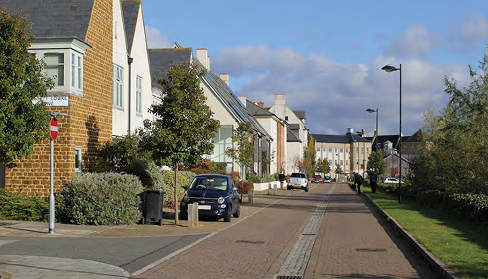
New roads and footpaths, and improvements to existing roads and footpaths, shall be supported and restrained by kerbing and concrete.
Kerbing
Road kerbs, channels and edgings shall be in accordance with Figures NA1 and NA2 of BS EN 1340 and laid on a base of ST4 (20N/mm²) concrete.
Road kerbs shall be 125mm x 255mm half battered (HB2) to create separation between roads and footpaths. Dropped kerbs used at vehicle and pedestrian crossing points shall be 125mm x 150mm (BN2).
Tapered kerbs to vehicle and pedestrian crossing points shall be 125mm x 255mm reducing to 125mm x 150mm.
Radius kerbs or radius channels shall be used on curves with a radius of 15 metres or less. For radii between 15m and 80m inclusive, 600mm straight kerbs shall be used unless channels are required, in which case radius kerbs and channels shall be used.
The minimum cut length of a kerb shall be 450mm and a trowel-width gap shall be left at the front face of a radius.
Road kerbs shall be laid on a 150mm x 380mm concrete base.
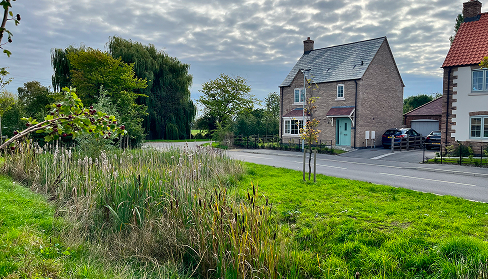
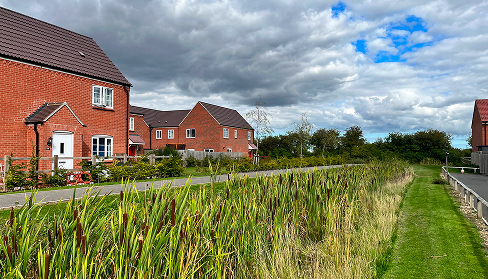
Sustainable drainage system (SuDS) kerbing may utilise various inlet methods to promote water flow from new roads and footpaths into the drainage system.
The options below are provided as typical details for reference only. The selected method shall be designed specifically to suit the layout of the new road and footpath.
Channel blocks shall be used on impermeable roads with a longitudinal gradient between 1 in 150 and 1 in 250 along the face of the road kerb. Channel blocks should incorporate a false slope where longitudinal gradients are less than 1 in 250.
Channel blocks shall be 125mm x 255mm Type CS1 and laid on a 150mm x 300mm concrete base.
Footpath edgings, known as External Flat (EF) precast concrete edgings, shall be used adjacent to footpaths and vehicle entrances. They shall be laid on a 75mm x 330mm concrete base.
All kerbing shall be bedded on a 25mm layer of cement mortar. Concrete bedding and haunching shall consist of ST4 (15N/mm²) concrete of low workability.
The kerb and channel bed on new roads shall always be laid separately from the backing. This enables damaged kerbs to be replaced at a later stage of construction while minimising damage to the surrounding works.
Alternative kerbing methods may be used on bituminous roads where road kerbs are to be installed later as part of a two-stage construction process. In these cases, the initial binder course shall be 70mm thick and the separate kerb base shall be used for level control.
Any sacrificial blocks or temporary road kerbs shall be removed and replaced with the approved road kerb before laying a further 60mm binder course and/or constructing footpaths.
Should the road binder course not provide a suitable line for the road kerb to be laid, there may be a requirement to inlay plane part of the road to ensure a perfect seal between the kerb and road binder course.
Damaged kerbing shall be replaced prior to the application of the final road or footpath surface course. Road kerbs shall be removed from the footpath or verge side unless the road binder course is still to be laid or repaired.
Where kerbing replacement is required after the final surface course has been laid:
A minimum two-metre length of surface course across the full width of the footpath shall be replaced.
If the adjacent road surface course is damaged, a minimum five-metre length of surface course shall be replaced across half the width of the road.
Where more than four separate road kerbs, channels or edgings are damaged within any ten-metre length, the entire ten-metre length shall be replaced.
Following completion of all surfacing works, minor kerb damage may be repaired using a HAPAS-approved epoxy kerb repair product, preferably incorporating a priming system. Such products shall not be used on conservation kerbing or on kerbing that has not yet received the final surfacing.
Concrete
Concrete shall be ready-mixed concrete complying with BS 8500-1:2023 and BS EN 206:2013. The maximum aggregate size shall be 20mm.
Suppliers shall be members of the Quality Scheme for Ready Mixed Concrete (QSRMC) and operate a quality management system in accordance with BS EN ISO 9001:2015.
Concrete compressive strengths are defined by both cylinder strength and cube strength. The first (lower) value represents the cylinder strength requirement and the second (higher) value represents the cube strength requirement.
Fresh concrete shall not be placed against concrete that has been in position for more than 30 minutes unless an approved construction joint has been formed.
Standard prescribed concrete shall be in accordance with the specified concrete mixes and strengths. However, it shall not be used where:
Sulphates or other aggressive chemicals are present in the groundwater
The concrete will be subjected to road de-icing salts
In these circumstances, a suitable concrete mix, including any required admixtures and cement containing additives, shall be submitted to and approved by us before use.
Standardised prescribed concrete
Strength Class for structural design
Compressive cube strength at 28 days (N/mm²)
ST1
C6/8
8
ST2
C8/10
10
ST3
C12/15
15
ST4
C16/20
20
ST5
C20/25
25
Contents
Site batched concretemay be acceptable where small quantities of concrete are required and the use of ready mix concrete would be prohibitively expensive. Site batched concrete will only be permitted in unreinforced applications and shall be in accordance with the table below.
Compressive Strength (N/mm²)
Coarse
Fine
Cement
C12/15
4
2 ½
1
C16/20
4
2
1
C25/30
3
1 ½
1
Contents
Recycled low grade concrete mixes with 10% recycled aggregate may be used in footpath edgings and, sign and street name plate foundations. This should not be used for structural, drainage or kerbing works.
When recycled concrete aggregate is used, it shall not have more than 1% by mass of foreign materials including wood, plastic and metal nor a floating material in volume content exceeding 10cm³/kg when tested in accordance with BS EN 933-11.
Compaction shall be required for all concrete to produce a dense uniform mass. It shall be compacted with the assistance of vibrators, care being taken to avoid contact with reinforcement and inserts.
All concrete shall be compacted in its final position within 30 minutes of being discharged from the mixer unless carried in continuously operated purpose-made agitators, when the time shall not be more than 2 hours after the introduction of the cement.
Curing of all concrete shall be required for 24 hours before any fresh concrete is placed adjacent to the cured concrete.
Immediately after completion and for 7 days thereafter, concrete shall be protected against harmful effects of weather, including rain, rapid temperature changes, frost and from drying out.