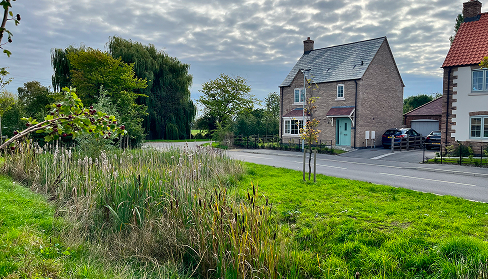
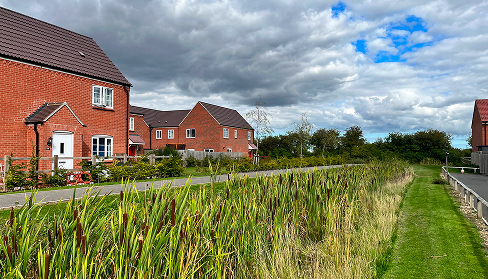
The following species are acceptable for sustainable drainage systems:
Betony
Devils Scabious
Musk Mallow
Oxeye Daisy
Purple Loosestrife
Red Campion
Salad Burnet
Selfheal
White Campion
Common Knapweed
Common Sorrel
Creeping Buttercup
Ladys Bedstraw
Meadow buttercup
Meadowsweet
Ragged Robin
Wild Carrot
Wild Red Clover
Yarrow
Grasses
The following species are acceptable for sustainable drainage systems:
Creeping Bent
Meadow Foxtail
Sweet Vernal Grass
Crested Dogstail
Slender Creeping Red Fescue
Smoothstalked Meadowgrass
Quaking Grass
Slender Creeping Red Fescue
Mixture of Trees
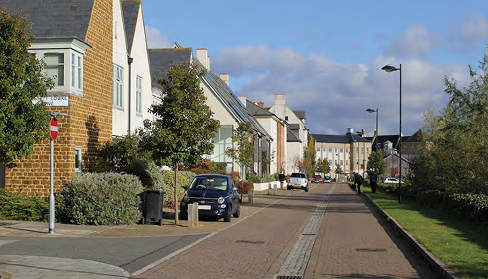
To ensure future-robust tree populations, no single tree species shall account for more than 10% of the trees on a single street, no more than 20% from a single genus, and no more than 30% from a single family, in accordance with Part B. Where there is sufficient space, larger trees provide more environmental benefits than small trees.
Where trees are to be located within paved or hard landscape areas, tree pits shall be designed to provide sufficient rooting volume to support healthy long-term growth, using appropriate engineered solutions such as structural soils, modular systems, or linked trenches where necessary.
This list is indicative and should be used in conjunction with the design code requirements for species diversity, street character, and placement. Final species selection must consider site-specific conditions including soil type, available rooting volume, proximity to infrastructure, and street typology.
Suitable for narrow verges, restricted spaces and 5-10m from streetlights.
Native to UK, high value to wildlife:
Betula pendula Fastigiata
Crataegus laevigata Paul's Scarlet
Fagus sylvatica Dawyck Fastigiate Beech
Ilex aquifolium Holly
Malus sylvestris Crab Apple
Prunus padus Bird cherry
Quercus robur Fastigiata (Koster)
Fastigiate, very narrow crown:
Betula pendula Fastigiata
Acer campestre William Caldwell
Cupressus sempivirens Italian Cypress
Fagus sylvatica Dawyck Fastigiate Beech
Prunus Amanogawa
Pyrus calleryana Chanticleer, Chanticleer Pear (over-used, alternative preferred)
Quercus palustris Green Pillar
Ulmus carpinifolia Wredei Aurea, small elm
Suitable for base of swales and narrow SuDS features
Acer rubrum Bowhall Red maple
Crataegus monogyna Common Hawthorn
Crataegus monogyna Stricta
Prunus padus Bird cherry
Pruns padus Waterii
Other small trees
Acer campestre Arends
Acer campestre Elegant
Acer campestre Elsrijk
Acer lobelli Lobel's maple
Amelanchier arborea Serviceberry
Amelanchier lamarckii Serviceberry
Arbutus unedo Strawberry tree
Betula ermanii
Crataegus lavalleei Hybrid Cockspur Thorn
Crataegus x prunifolia Broad-leaved Cockspur Thorn (thorny)
Malus huphensis Hupeh Crab Apple
Malus Rudolph
Prunus cerasifera Myrobolan Plum
Prunus x Hillieri Spire
Prunus Kanzan
Prunus sargentii
Prunus x subhirtella Autumn Cherry
Prunus Umineko
Sorbus aucuparia Asplenifolia
Sorbus aucuparia Cardinal Royal
Sorbus aucuparia Edulis
Sorbus aucuparia Sheerwater Seedling
Sorbus huphensis
Tamarix tentrandra Tamarisk, (tolerant of salt winds and soils)
Tilia mongolica Mongolian Lime
Large Trees
Suitable for open spaces and greater than 10 metres from streetlights:
Native to UK, high value to wildlife:
Acer campestre Field maple
Alnus glutinosa, Common Alder
Betula pendula Silver birch
Betula pubescens Downy birch
Carpinus betulus Hornbeam
Fagus sylvatica Common Beech
Pinus sylvestris Scots Pine
Populus tremula Aspen
Populus tremula Erecta
Prunus avium Wild cherry (unsuitable for paved areas, large surface roots)
Quercus petrea Sessile oak
Quercus robur English oak
Salix caprea Goat willow or sallow
Sorbus aria Whitebeam
Sorbus aucuparia Rowan
Tilia cordata Small-Leaved Lime (can drip sap)
Tilia x europaea Common Lime (typical of Victorian streets, often pollarded, can drip sap)
Taxus baccata Yew (common in churchyards, dark, poisonous berries)
Tilia platyphyllos Large-Leaved Lime
Fastigiate, very narrow crown:
Populus nigra Italica Lombardy Poplar (vigorous)
Populus tremula Erecta
Narrow trunk, suitable for base of swales and narrow SuDS features:
Alnus glutinosa, Common Alder
Betula nigra River birch
Tolerant of waterlogged soils, suitable for swales:
Alnus cordata Italian alder (vigorous surface roots, best for unpaved)
Alnus glutinosa, Common Alder (tolerant of flooding, suitable for swales)
Alnus incana Grey alder (tolerant of poor soils)
Betula nigra River birch (good for wet site such as swales)
Populus tremula Aspen (vigorous, good for wets sites)
Populus tremula Erecta
Salix caprea Goat willow or sallow
Taxodium distichum Swamp Cypress
Other large trees
Acer negundo Box elder
Acer platanoides Norway maple
Acer pseudoplatanus Sycamore
Aesculus x carnea Red Horse Chestnut
Ailanthus altissima Tree of heaven
Betula albosinensis Fascination Chinese Birch
Betula papyrifera Paper birch
Betula utilis Himalayan birch
Carpinus betulus Fastigiata
Castanea sativa Sweet Chestnut
Catalpa bignonioides Indian Bean Tree
Cedrus atlantica Atlas Cedar
Cedrus deodara Deodar Cedar
Cedrus libani Cedar of Lebanon
Celtis australis Nettle Tree
Corylus colurna Turkish Hazel
Ginkgo biloba Maidenhair Tree
Gleditsia triacanthos Honey Locust
Juglans nigra Black Walnut
Juglans regia Common Walnut
Larix decidua Common Larch
Liquidambar styraciflua Sweet Gum
Liriodendron tulipifera Tulip Tree
Metasequoia glyptostroboides Dawn Redwood
Ostrya carpinifolia Hop Hornbeam
Pinus nigra Austriaca Austrian Pine (large pine tree useful for coastal locations)
Platanus x hispanica London Plane (very large, tolerant of air pollution)
Platanus orientalis Oriental Plane (large, decorative)
Quercus ilex Holm oak, evergreen
Quercus rubra Red oak
Robinia pseudoacacia False acacia
Robinia pseudoacacia Frisia, yellow form
Salix alba Tristis (x sepulcralis Chrysocoma) Golden Willow, weeping
Sequioadendron giganteum Wellingtonia or Giant redwood (very vigorous)