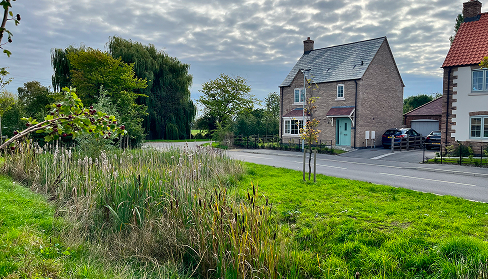
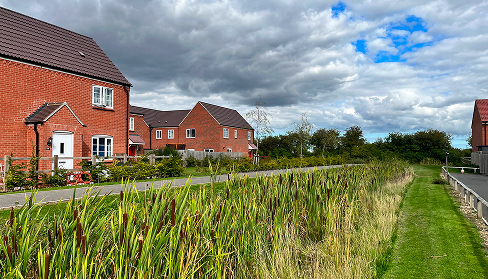
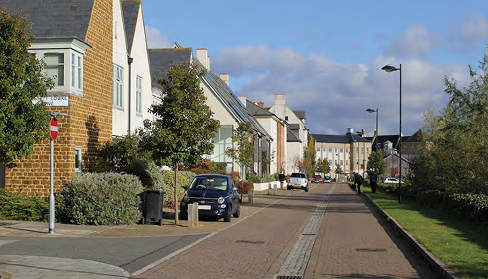
Following application approval and payment of the relevant fees, you shall arrange a meeting with us before the new roads and footpaths are built. If the road and footpath build starts without application approval and a meeting taking place, it will be at your risk and we reserve the right not to enter into a legal agreement.
Approved Materials
All materials for public roads and footpaths shall be obtained from a source and supplier approved by the County Council. Please refer to the Approved Suppliers List. See also the material palette for acceptable block paving.
Inspections of Roads and Footpaths
We shall be given a minimum of five working days' notice and you shall provide facilities for our authorised representative to carry out inspections and testing.
Public road and footpath improvements shall be inspected and tested at relevant stages of construction, depending on the scope of the improvement. Certification will be issued upon satisfactory completion of the works.
New roads and footpaths shall be inspected and tested at ten key construction stages (Stages 1 to 10). We will certify key Stages 5, 9 and 10, subject to satisfactory completion and compliance with the approved schedule. Any part of the works that is not inspected by us will not be certified unless it can be demonstrated as acceptable through additional testing and supporting interpretive reports.
Any part of the works that does not comply with our approved detailed design shall be removed and replaced at your expense.
We will adopt new roads and footpaths through a Section 38 Road Adoption Agreement following certification of Key Stage 10.
Testing of Build Materials
To ensure roads and footpaths are constructed in accordance with our approved detailed design, all materials used in their construction shall be tested by a UKAS-accredited laboratory that is specifically accredited for the tests required.
Details of the source and type of material being tested shall be provided for all testing.
Capping and Sub-base Material Testing
Plate Bearing and/or Light Drop Weight testing shall be undertaken to assess the strength of compacted capping and/or sub-base material prior to the laying of the binder course.
Plate Bearing testing shall use a mobile counterweight, known as a kentledge, with a minimum weight of 10 tonnes. The plate diameter shall be between 100mm and 300mm, depending on the thickness of the material being tested.
Light Drop Weight testing shall use a dynamic plate loading technique, such as a Light Drop Weight Tester (Dynamic Plate Tester). Such devices shall be calibrated against plate bearing apparatus for the particular type of material being tested. Evidence of this comparative testing may be requested.
Plate Bearing tests shall be carried out at intervals of between 50 metres and 100 metres, with a minimum of two test locations. Light Drop Weight tests shall be undertaken at intervals not exceeding 20 metres.
The minimum Modulus of Subgrade Reaction value shall be 30MPa for capping material and 35MPa for sub-base material.
The method used to calculate the equivalent CBR value from the Modulus of Subgrade Reaction shall be detailed within the Test Procedure submitted for approval. The test report shall include:
First loading CBR (%) and EV1 value.
Second loading EV2 value.
EV2/EV1 ratio.
EV represents the Modulus of Deformation.
Testing shall be carried out:
In accordance with a procedure approved by us and submitted prior to testing.
In a manner that ensures the results are representative of the full depth of capping and/or sub-base material.
At least five working days before the binder course is laid.
At a sufficient number of locations.
The capping material shall achieve an equivalent CBR value greater than 15%, and the sub-base material shall achieve an equivalent CBR value greater than 30% at the surface of the finished layers, as determined by the Plate Bearing test.
Surface Water Pipe Testing
The integrity of surface water pipes shall be tested and all tests shall be witnessed by us. Surface water pipes include all or part of the sewer system that is to be adopted by us.
Surface water pipes up to and including 750mm nominal diameter shall be tested by means of an air test. Surface water pipes greater than 750mm nominal diameter shall be assessed by visual examination. Visual examination may include CCTV surveys and/or walk-through inspections.
Surface water pipes undergoing air testing shall be cleansed and have air introduced until a pressure equivalent to 100mm head of water is indicated in a U-tube connected to the system. The pipe shall be deemed acceptable if, after a stabilisation period, the pressure remains above 75mm head of water for five minutes without further pumping.
CCTV surveys shall be required for all perforated pipeline systems.
Regardless of satisfactory completion of testing, if any discernible flow of water entering sewers or manholes is identified through visual inspection or CCTV survey, appropriate remedial measures shall be undertaken by the person constructing the road to eliminate the flow.
Following completion of construction and cleansing of the surface water system, a CCTV survey shall be undertaken for all surface water pipes, including gully pipes and culverts.
The CCTV survey shall be reported in accordance with BS EN 13508-1:2012 and BS EN 13508-2:2003+A1:2011 and submitted to us. Surface water pipes shall not be certified until any defects identified in the survey report have been repaired.
Core Sampling
Core sampling of the bituminous pavement shall be carried out in accordance with BS EN 12697-27:2017 using cores with a diameter of 150mm. Testing shall confirm that:
The material contains approved aggregate.
The pavement has been laid to the correct thickness.
The required compaction has been achieved.
A bond exists between bituminous layers.
Determination of thickness, compaction and bond shall be undertaken in accordance with an approved in-house testing method.
Core densities shall be determined using dried core specimens that have been oven-dried at 40°C to a constant mass, in accordance with BS EN 12697-6:2020.
Air void content shall be determined in accordance with BS EN 12697-8:2018.
The bond between bituminous layers shall be assessed using 150mm diameter cores extracted from cold material. Bond shall be deemed satisfactory where detachment does not occur when the core is suspended vertically for one minute.
Compliance shall be achieved when no more than one in ten cores taken from any area fails the bond test.
Bituminous layers will be certified when supplied by an Approved Supplier and when they comply with the relevant build tolerances.
Replacing Failed Material
Where a new road or footpath fails to comply with the specified build tolerances, the non-compliant area shall be replaced.
For defects relating to surface level or layer thickness, remediation shall be achieved through partial or complete removal and replacement of the existing binder course layer. Sufficient material shall be planed off to enable installation of a replacement binder course.
For roads, the replacement binder course shall have a minimum compacted thickness of 60mm. For footpaths, the minimum compacted thickness shall be 50mm.
No regulating course shall be permitted within the surface course layer.
Key Stage Certificates
The developer is required to ensure the below inspections and testing by an authorised representative of Lincolnshire County Council at the correct time in accordance with the Section 38 Agreement.
Responsibility for the works, and ensuring supervision and delivery in accordance with the specification and approved design lies with the developer.
The developer should provide a minimum of 5 working days’ notice to provide facility to carry out the inspections and tests detailed in each of the following key stages. Random additional bulk sample testing may also be carried out.
Should the developer fail to notify or allow facility for the key stage inspection, the retrospective testing details must be provided. In this instance only tests carried out by a UKAS accredited laboratory will be acceptable.